Netflix Puzzled
- 4.4
- Rating
- 1.00M
- Installs
- Free
- Price
 Analysis by App-foxy
I approached Netflix Puzzled as the sort of game I could open without setting aside an entire evening. It is a word-focused puzzle game from Netflix, Inc., built around short sessions and a rotating-feeling mix of logic and language challenges. The appeal is not a single huge campaign or a complicated competitive system; it is having several different ways to exercise your attention when you have a few quiet minutes.
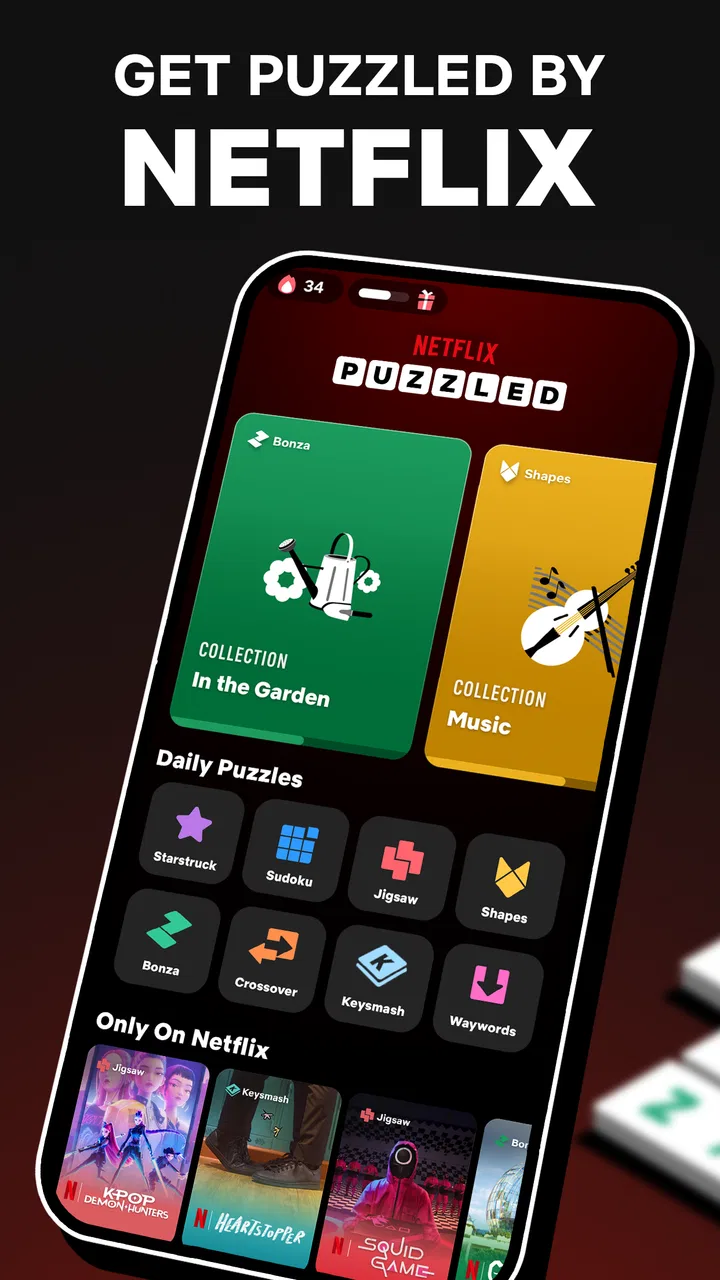
My first impression was that the game makes more sense when treated as a daily mental break rather than as one traditional word game. Sudoku asks for deduction, Bonza asks you to assemble language, Jigsaw changes the pace with visual arrangement, and Keysmash adds a more playful word-based challenge. That variety is the main reason I would recommend trying it instead of downloading several separate puzzle apps.
The game is free, carries a Teen content rating, and has reached more than 500 thousand installs. Its average rating is 4.7 from roughly 2.9 thousand ratings, which suggests that the central idea is landing well with many players. I still think the right question is not whether it is popular, but whether you enjoy switching between puzzle styles instead of mastering one format.
You May Also Like

 Blood Strike: 2.5 Anniversary
Blood Strike’s Loadouts Turn Every Drop Into a Tactical Gamble
A close look at Blood Strike’s custom loadouts: how fast access to signature weapons reshapes its battle royale rhythm, rewards preparation, and narrows the gap between fights.

 Pandora - Music & Podcasts
Pandora’s Music Is Easy to Start, but Harder to Recover
Pandora’s strength is its low-effort path from a seed to a station. Its weak spot is how much confidence it asks you to place in connection, setup, and quiet recovery.

 8 Ball Pool
 Is Built on Rivalries, Rematches, and Routine
A close look at the rivalries, rematches, shared routines, and unanswered safety questions that turn a quick pool match into a persistent mobile community.

 Samsung Music
’s Quiet Strength Is Playing What You Already Own
Its reach comes less from spectacle than from dependable access to a personal library. That simplicity is both the app’s strongest retention engine and its ceiling.

 AccuWeather: Weather Radar
AccuWeather Review: A Quick, Clear Forecast for Everyday Decisions
For everyday plans, the best forecast is the one you can understand quickly. AccuWeather makes rain timing, radar, and local conditions easy to act on, with a few trade-offs.

 Hill Climb Racing
Why Hill Climb Racing Still Turns Crashes Into One More Run
A tiny car, a bumpy hill and one more upgrade: Hill Climb Racing keeps resurfacing because its simple chaos makes every near-miss feel personal.
More From Our News Desk



What to expect when you open the game
Netflix Puzzled is best understood as a collection of daily logic and word puzzles. The different formats give the app a broader personality than a standard crossword or standalone Sudoku title. I found that useful because my mood changes: sometimes I want a clean deduction problem, while at other times I prefer manipulating pieces or finding a language connection.
That variety also means the experience is less predictable than a focused puzzle app. If you install a dedicated Sudoku game, you already know what every session will ask of you. Here, the next activity may require a different kind of concentration. That can keep the routine fresh, but it may disappoint someone who wants a deep progression system built around one precise skill.
The word category is slightly misleading if you expect only spelling grids or clues. Sudoku is clearly a logic exercise, and Jigsaw is more visual. I see the combination as the point: the game lets you move between verbal reasoning, pattern recognition, spatial awareness, and deduction without leaving the same app.
For a first-time player, I would avoid judging the whole package from the first puzzle alone. One format may suit you immediately while another may feel awkward. Give each type a fair attempt, then notice which ones make you want to solve “just one more.” That personal preference matters more here than a universal ranking of the included games.
The daily structure is also important. This is not the best choice if you want an endless library of increasingly difficult boards at any hour. Daily puzzle design encourages a small, repeatable habit. I like that limitation when I want a boundary around screen time, although players who enjoy grinding through dozens of puzzles may find it restrictive compared with large standalone collections.
Because it comes from Netflix, the game also fits most naturally into the company’s broader entertainment ecosystem. The developer is Netflix, Inc., and the app is presented as a free game rather than a separate paid puzzle purchase. Before installing, I would make sure the Netflix account experience works comfortably for you, because the value of this title is tied to being part of that service rather than functioning like an entirely isolated premium download.
Setting it up without overthinking the first screen
The current version is 7.1.0, and the minimum operating system is Android or iOS 10. Once installed, I recommend taking a moment to understand the entry path instead of tapping quickly through every screen. The most useful first decision is simply which puzzle format feels approachable. You do not need to begin with the one that looks most familiar.
A good first setup routine is to choose a quiet moment, open the game with enough time for one complete attempt, and keep a note of which format you selected. That may sound unnecessary, but it helps separate two different reactions: “I dislike this particular puzzle” and “I dislike the whole app.” With a multi-format game, those are not the same thing.
I would also begin with the easiest-looking challenge rather than trying to prove that I can solve the hardest one immediately. Early success teaches the interaction style: how pieces move, how answers are entered, and how the game indicates progress. That small amount of familiarity makes later mistakes feel like part of solving rather than a sign that the app is difficult to use.
One practical advantage of this setup is that you can build a personal rotation. For example, I might use Sudoku when I want a quiet, methodical session, Bonza when I want to work with word relationships, and Jigsaw when I am mentally tired but still want something active. The app becomes more useful when I choose the format based on my attention level instead of following a fixed routine.
There is a trade-off here. A unified puzzle app is convenient, but it may not give each discipline the same depth as a specialized alternative. A dedicated Sudoku app will usually be the better fit for someone who wants detailed solving tools and a large progression. A crossword or word-search specialist may offer more content in that one style. Netflix Puzzled wins on changing lanes quickly.
How to reach a first meaningful success
For the first attempt, I would start with the puzzle whose rules you can explain in one sentence. The goal is not to finish the most impressive challenge; it is to complete one board and understand why the answer works. That first successful action gives you a reference point for every other format in the collection.
With Sudoku, I find it helpful to look for the most constrained row, column, or box rather than scanning the entire grid randomly. Fill the obvious placements first, then use those new numbers to reduce the remaining possibilities. The useful lesson is patience: guessing early can create a chain of confusion, while a small deduction often opens the board naturally.
Bonza rewards a different habit. Instead of treating every word as an isolated answer, I look for groups that seem to belong together and then test how those groups might connect. If one arrangement leaves an awkward fragment, I reconsider the whole cluster rather than forcing a single word into place. That approach is especially helpful for players who are comfortable with vocabulary but less comfortable with visual rearrangement.
Jigsaw is a good first win for anyone who wants immediate, visible progress. I begin with pieces that have distinctive edges or colors, then use the emerging image to identify where less obvious pieces belong. The important trick is not to stare at one stubborn piece for too long. Place the easy sections, step back, and let the larger pattern provide the clue.
Keysmash can feel less straightforward because the name suggests randomness. I would approach it as a language puzzle rather than typing whatever comes to mind. Look for the relationship the game is asking you to notice, and pay attention to the wording around the task. When an answer feels arbitrary, rereading the prompt is often more productive than trying a long list of guesses.
My strongest beginner tip is to stop after a clean success, even if the game makes another puzzle tempting. Ending on a solved board creates a useful rhythm and makes it easier to return the next day. If you immediately turn a short break into a long session, the collection can lose the relaxed quality that makes it appealing in the first place.
Where new players commonly get confused
The biggest possible confusion is assuming that every puzzle follows the same logic. They do not. Sudoku depends on elimination, Bonza on assembling connected word groups, Jigsaw on visual placement, and Keysmash on interpreting a word-oriented prompt. Carrying the strategy from one format into another can make an easy challenge feel unnecessarily difficult.
I also noticed how easy it is to mistake unfamiliarity for poor design. A player who normally uses crossword clues may expect Bonza to behave like a crossword, while someone who plays Sudoku regularly may expect every number puzzle to offer the same kinds of assistance. The better approach is to spend one complete round learning the rules before deciding whether the format suits you.
Another source of friction is the daily nature of the experience. If you miss a day or do not feel like solving, the game does not necessarily provide the same satisfaction as an archive packed with old boards. That is not automatically a flaw; it is a design trade-off. The app is stronger as a recurring check-in than as a bottomless puzzle warehouse.
Players should also be realistic about the social side. I would not install this expecting a major multiplayer competition or a fully developed community around every answer. Its core pleasure is personal solving. If your ideal word game depends on head-to-head matches, public leaderboards, or sharing elaborate results, a dedicated competitive title may serve you better.
Difficulty can be subjective too. A puzzle that is relaxing for a vocabulary enthusiast may be frustrating for someone who prefers numbers, while a Sudoku fan may find a word arrangement slow. I would not use one difficult attempt as evidence that the whole game is inaccessible. Switch formats, return later, and see whether the problem was the challenge type rather than the general usability.
The Teen rating is worth keeping in mind for households choosing games for younger players. I would not treat a word-puzzle label as a guarantee that it is suitable for every child. Parents should make their own decision based on the rating and the way the game fits into the family’s existing Netflix use.
A realistic everyday routine
Imagine having a ten-minute gap before leaving for work or while waiting for an appointment. Instead of opening a social feed and losing track of time, I could complete one Sudoku section or work through a compact word challenge. If I get stuck, I can stop without abandoning a long story, a multiplayer team, or a carefully built character.
On a tired evening, I might choose Jigsaw because arranging pieces feels more tactile and less demanding than searching for an exact word. On a sharper morning, I could choose Sudoku and use the grid as a focused warm-up. Bonza works well when I want language play, while Keysmash is a better change of pace when familiar puzzle routines start feeling repetitive.
This is one of the app’s less obvious strengths: it can match the puzzle to the kind of attention you have available. Most single-format apps ask you to adapt yourself to their rules. Here, I can adapt the activity to my mood. The limitation is that the choice only helps if I enjoy several formats; someone who dislikes wordplay and visual puzzles will not gain much from the variety.
I would use the game differently on a commute if I knew I might be interrupted. A short daily challenge is easier to fit around interruptions than a long campaign, but I would still avoid beginning a puzzle that requires uninterrupted concentration when I am about to arrive. The most satisfying sessions are the ones where the time available matches the puzzle’s mental demand.
How it compares with familiar alternatives
Compared with a standalone Sudoku app, Netflix Puzzled is broader but less specialized. A Sudoku-only player may prefer the alternative because every screen, tool, and difficulty choice supports one activity. I would choose Netflix Puzzled when I want Sudoku available alongside other formats and do not want several separate apps competing for space and attention.
Against crossword, word-search, or anagram apps, it offers more variety but less single-minded depth. A specialist can provide a stronger vocabulary routine or a larger archive in one style. This game is better for someone who wants language puzzles as one part of a wider daily habit, not for a player who measures value by the size of one particular puzzle library.
It also differs from large casual-game collections that fill every moment with levels, rewards, or constant progression. Netflix Puzzled feels more restrained. That can be refreshing if you want the solving itself to be the reward. It can feel thin if you need unlocks, elaborate customization, or a strong sense of long-term advancement to stay interested.
The free price is a meaningful advantage for existing Netflix users who want another low-pressure activity within that ecosystem. I would not view it as a reason by itself to choose the game over every specialized alternative. The real value comes from combining several puzzle types in one place and returning to them regularly.
Who should try it, and who should skip it
I think it is a strong match for casual solvers, people who enjoy switching between number and word challenges, and anyone looking for a short daily ritual rather than a sprawling game. It is also a sensible option for households where different players like different puzzle styles, since one person can prefer Sudoku while another gravitates toward Jigsaw or Bonza.
I would be more cautious if you want a single expertly focused discipline. A serious Sudoku enthusiast, a dedicated crossword solver, or a player seeking competitive word matches may find a purpose-built app more satisfying. Likewise, if you dislike daily formats and want to play through a large back catalogue whenever inspiration strikes, this may not fit your preferred rhythm.
Players who need a dramatic narrative, character progression, or action should also look elsewhere. This is a quiet puzzle collection, and its success depends on whether the act of noticing patterns and finding answers is enough to keep you engaged. I appreciate that simplicity, but I would not pretend it offers the excitement of a story-driven game.
What I would do after the first session
After completing the first puzzle, I would not immediately settle on a favorite. I would try one challenge from each format across separate short sessions and rate them informally by effort, enjoyment, and how easy they are to pause. That gives a more useful picture than judging the app by its opening activity.
I would then create a simple rotation based on my schedule: a logic puzzle when I want concentration, a word arrangement when I want language practice, and a visual board when I need something lighter. This turns the variety from a menu into a practical routine. It also prevents the game from becoming another app I open automatically without knowing why.
If a puzzle feels impossible, I would first change formats rather than repeatedly forcing the same answer. That is not giving up; it is using the collection intelligently. Returning later with a different mental state can reveal a pattern that was invisible during the first attempt.
My overall view is positive, with a clear qualification. Netflix Puzzled is most enjoyable as a compact, varied word-and-logic break, not as a replacement for every specialist puzzle app. Its free access, Netflix connection, and mix of Sudoku, Bonza, Jigsaw, Keysmash, and other challenges make it easy to recommend to curious casual players. The best reason to install it is simple: you want several kinds of thoughtful play without turning a short break into a major commitment.
Released on November 20, 2025, it already has a solid audience and a 4.7 average rating, but those figures are less important than the fit with your habits. If you enjoy solving one small problem at a time and appreciate choosing between different kinds of thinking, I would give it a fair trial. If you want deep specialization, endless archives, or competitive pressure, I would point you toward a dedicated alternative instead.
FAQs for Netflix Puzzled
01What is Netflix Puzzled, and how does it work?
Netflix Puzzled is a puzzle game app available for both Android and iOS devices. It combines traditional puzzle mechanics with popular Netflix themes. Players solve various levels by arranging pieces to complete scenes from Netflix shows and movies. The app offers a wide range of difficulty levels, making it suitable for all ages.
02Is Netflix Puzzled free to download and play?
Netflix Puzzled is free to download from the Google Play Store and Apple App Store. While the game offers a range of free content, there are in-app purchases available. These purchases can unlock additional puzzles or provide hints and power-ups to enhance gameplay and overcome challenging levels.
03Do I need a Netflix subscription to play Netflix Puzzled?
No, a Netflix subscription is not required to play Netflix Puzzled. The game is independently accessible and does not require any login credentials from Netflix. However, having a subscription might enhance the experience as you recognize scenes and characters from your favorite shows featured in the puzzles.
04What are the system requirements for Netflix Puzzled?
Netflix Puzzled requires Android version 5.0 or higher and iOS version 11.0 or later. The app is optimized for both smartphones and tablets, ensuring a smooth gaming experience. For optimal performance, make sure your device has sufficient storage space and is running the latest operating system updates.
05Can I play Netflix Puzzled offline?
Yes, Netflix Puzzled can be played offline once it is downloaded and installed on your device. This makes it a perfect companion for travel or situations where a stable internet connection is unavailable. However, some features, such as in-app purchases and updates, will require an internet connection.
Pros
- Engaging puzzles with a Netflix theme.
- Features characters from popular Netflix shows.
- Regular updates with new challenges.
- User-friendly interface and controls.
- Offline mode available for puzzles.
Cons
- Requires a Netflix subscription to access.
- Limited to specific regions initially.
- In-app purchases can be expensive.
- Some puzzles may feel repetitive.
- Occasional bugs in older devices.

Netflix Puzzled
Gallery